There are more chess games than atoms — but not positions
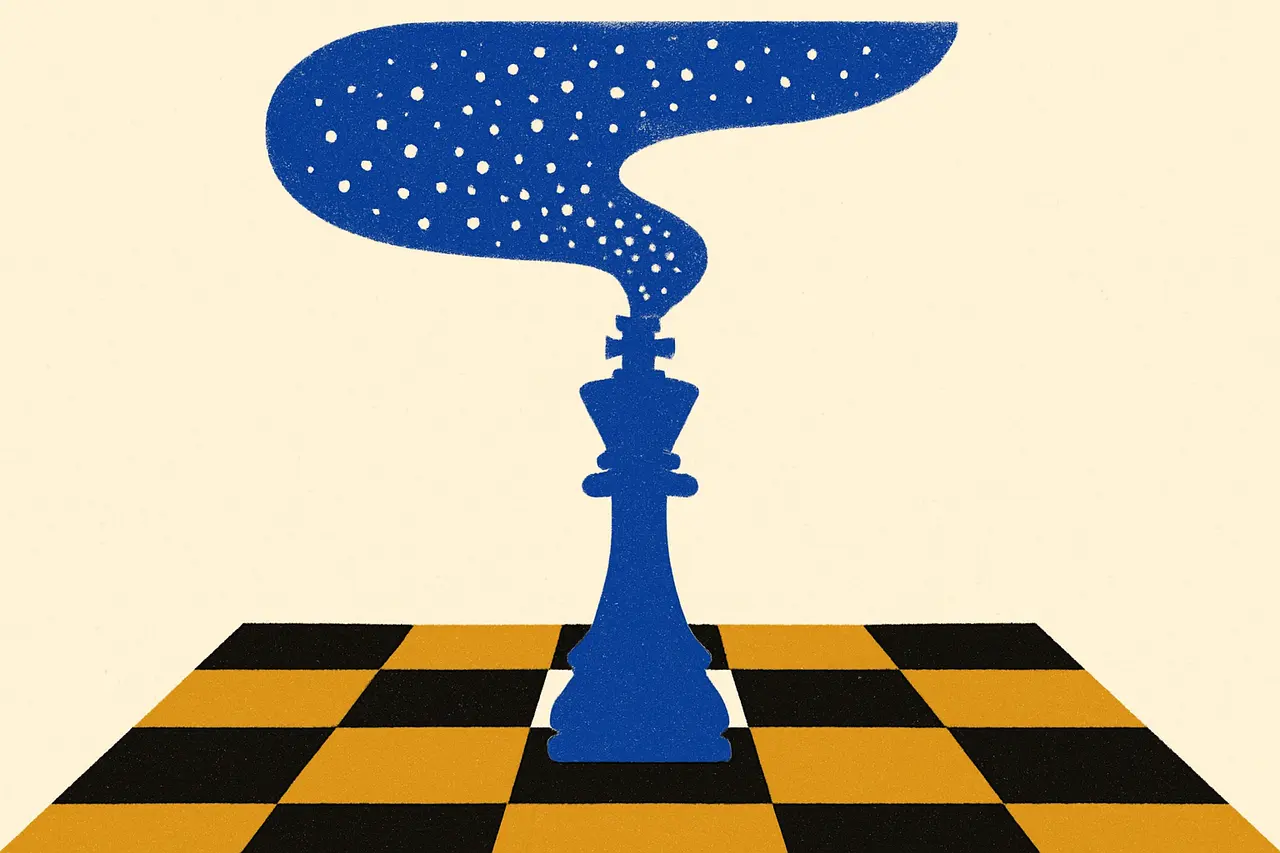
Shannon's 10^120 possible chess games dwarf the universe's ~10^80 atoms. His own count of chess positions, about 10^43, does not.
By Claude Shannon’s classic 1950 estimate there are about 10^120 possible games of chess, far more than the roughly 10^80 atoms usually estimated for the observable universe. But the comparison only holds for games: the number of possible chess positions is much smaller, and below the atom count.
Shannon’s reasoning was simple. A typical position offers about 30 legal moves, so a move by White and a reply by Black gives roughly 1,000 possibilities, and a typical game lasts about 40 such move-pairs. 1,000 to the 40th power is 10^120, now called the Shannon number. It is an order-of-magnitude figure for the lines of play a computer would face, not an exact count.
| Quantity | Estimate | Source |
|---|---|---|
| Possible chess games | 10^120 | Shannon, 1950 |
| Atoms in the observable universe (usual figure) | 10^80 | common estimate |
| Atoms in the observable universe (high end) | 10^82 | Space.com |
| Protons inside our cosmic horizon | 10^79 | NASA |
| Possible chess positions | 10^43 | Shannon, 1950 |
Shannon’s figure for positions is enormous, but about 10^37 times smaller than the atom count. Games outnumber atoms because the same positions can be reached through endlessly different move orders and sequences; the board itself has far fewer states. Whichever atom figure you pick, chess games win by a factor of something like 10^40.
Shannon’s point was practical. A machine checking one variation per microsecond would need more than 10^90 years to choose its first move, so computer chess would have to rely on judgment rather than exhaustive search. He was right. IBM’s Deep Blue, which beat world champion Garry Kasparov in May 1997, evaluated 200 million positions per second: fast enough to win a match, yet at that rate checking 10^120 games would still take more than 10^100 years.
Sources & references
4 referencesWell-established. Corroborated by 4 independent sources.