Theodore Maiman built the first working laser in 1960
On this day · 16 May 1960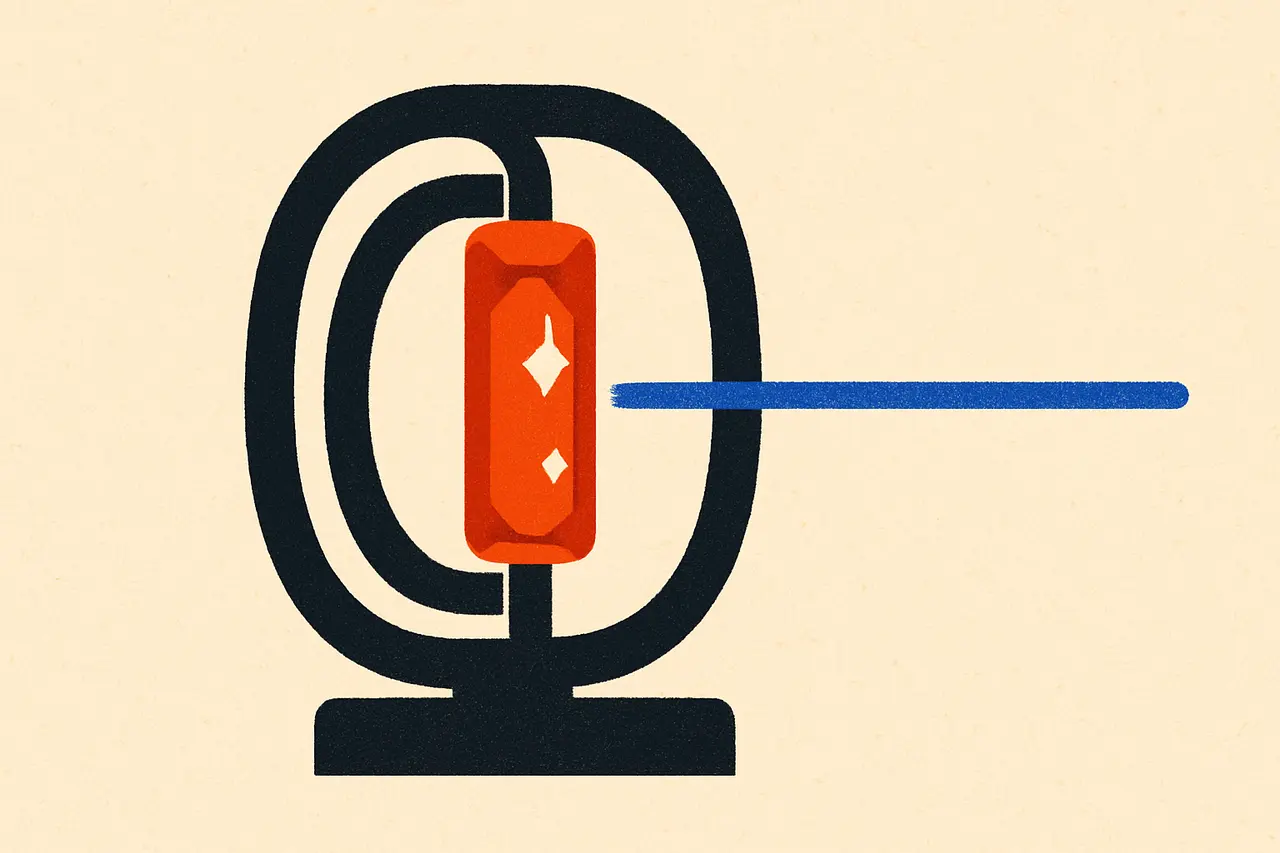
In May 1960 a small ruby inside a flash lamp became the first laser. It made no bright beam, and a top journal rejected it.
The first working laser was demonstrated by physicist Theodore Maiman at Hughes Research Laboratories in Malibu, California, on 16 May 1960, using a pink synthetic ruby about 1 by 2 centimetres with silvered ends, placed inside a coiled xenon photographic flash lamp. Colleagues Irnee D’Haenens and Charles Asawa helped power it up.
Maiman won the race by going against expert opinion. Several scientists had written ruby off, and Arthur Schawlow, co-author with Charles Townes of the theory of the optical maser, had argued publicly that ruby’s ground-state transition would not work. Maiman found that the accepted calculations of ruby’s efficiency were wrong, and pumped it with a brief, intense flash.
The first laser produced no dramatic red beam, a detail often told wrong: the device was not set up to let a simple beam out. As the flash energy rose, the faint 694.3-nanometre glow gave way to abrupt, intense pulses and the light’s spread of frequencies narrowed sharply, which was the proof of laser action. Townes later recalled asking the Hughes team whether they had seen a bright beam; they had not.
Hughes announced the result in New York on 7 July 1960, where Maiman told reporters:
“For the first time in history a source of ‘coherent’ light has been attained.”
The press talked of death rays, and the laser was soon called “a solution looking for a problem,” while the work moved fast:
- June 1960: Maiman publishes a ruby paper. Physical Review Letters then rejects his laser report, not, as is sometimes said, because of a ban on maser papers: editor Simon Pasternack said it looked like more of the same.
- August 1960: Nature prints a short version.
- Late 1960: Before the year is out, IBM and Bell Labs have built other kinds of laser.
- 1969: A ruby laser bounces pulses off a reflector on the Moon.
Sources & references
3 referencesWell-established. Corroborated by 3 independent sources.