The universe's total energy may be exactly zero
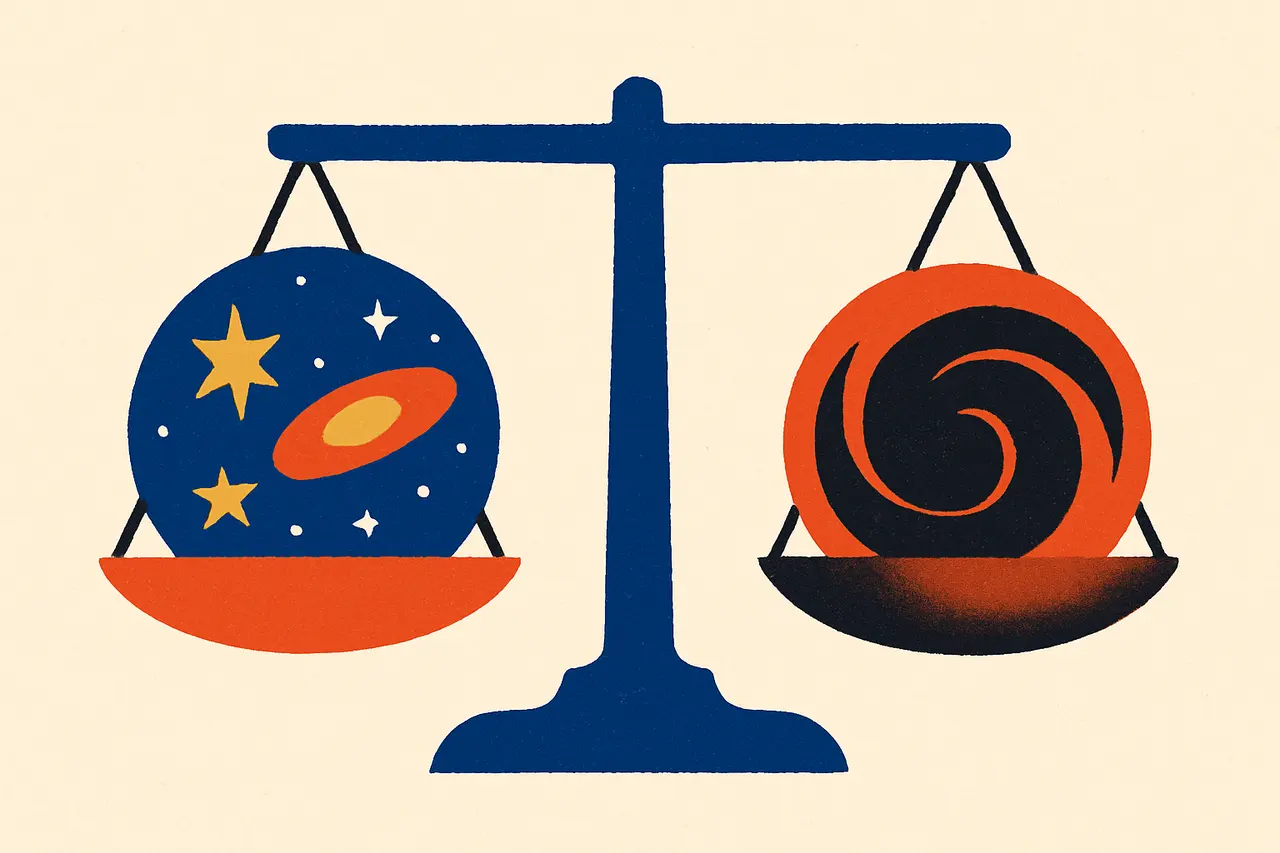
Matter's positive energy may be cancelled exactly by gravity's negative energy. Why some physicists believe it, and why the answer depends on definitions.
Some physicists argue that the total energy of the universe is exactly zero: the positive energy of all its matter and radiation would be cancelled precisely by the negative energy of gravity. It is a serious idea, not a measurement, and whether it is even meaningful depends on how energy is defined in Einstein’s theory.
The intuition comes from everyday gravity. Pulling two masses apart takes energy, so a bound pair has less energy than the same pair far apart, and gravity’s contribution counts as negative. As Stephen Hawking put it, in a roughly uniform universe “this negative gravitational energy exactly cancels the positive energy represented by the matter.” If so, making a universe costs nothing, which is why Alan Guth, a founder of inflation theory, called it “the ultimate free lunch.”
The proposal traces to Edward Tryon of Hunter College in New York, who asked in Nature in December 1973 whether the universe is a vacuum fluctuation. His model predicted a closed universe made of equal parts matter and antimatter.
Why it isn’t settled
- Gravitational energy is slippery. The “pseudo-tensors” used to total it up change with the choice of coordinates, and most relativists distrust them as a local measure of energy.
- For a closed universe, zero is close to automatic. By the Hamiltonian definition, the energy of any closed universe always works out to zero, so the result can look more like bookkeeping than discovery.
- Ours may not be closed. NASA’s WMAP satellite measured the curvature of space to within 0.4% of flat, not the closed shape Tryon’s model required.
- The sums may not balance. A 2013 calculation by Nikodem Popławski, in an extension of general relativity, did find zero for a closed universe, but because visible matter’s positive energy outweighs gravity’s negative energy, the books balance only with an unseen negative-energy matter, which he suggested might be dark matter.
The zero-energy universe remains a coherent possibility, not an established fact.
Sources & references
5 referencesContested. Corroborated by 5 independent sources.