Quantum tunnelling lets a microscope see single atoms

Electrons can slip through barriers they should not cross, and that quirk powers a microscope 2,000 times sharper than any light microscope.
Quantum tunnelling lets particles such as electrons cross an energy barrier that classical physics says they lack the energy to climb, and it is the principle behind the scanning tunnelling microscope (STM), which maps surfaces one atom at a time.
Because quantum particles behave as spread-out waves, part of the wave leaks through a thin barrier, so there is a real chance of finding the particle on the far side. That chance falls off steeply as the barrier widens. In an STM the barrier is the tiny gap between a needle tip sharpened to a single atom and a surface about two atom diameters away. The current that tunnels across is so sensitive to the gap that, by keeping it constant, the tip traces the surface’s bumps atom by atom.
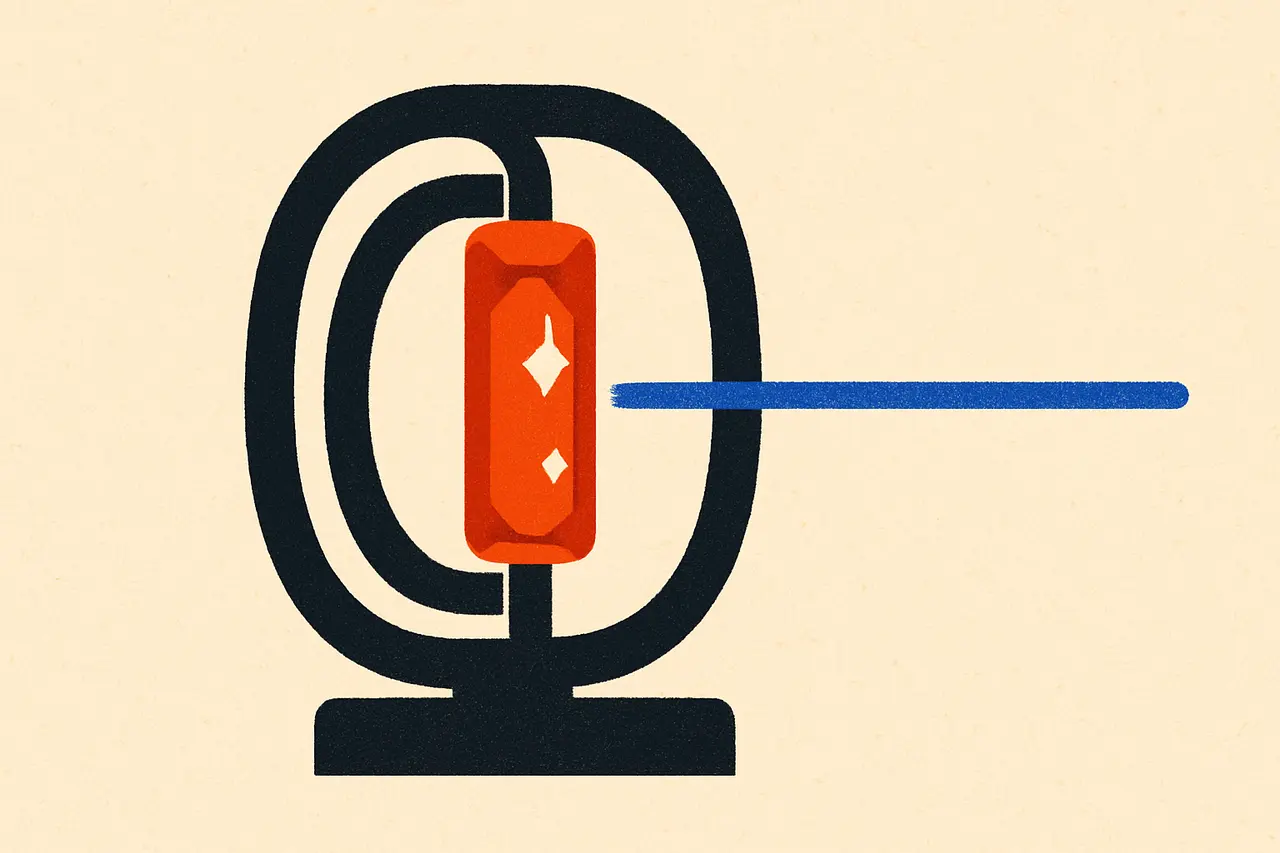
The idea predates its inventors. Russell Young at the US National Bureau of Standards had already scanned metal surfaces with a related effect and realised tunnelling should give finer detail, but the experimental difficulties defeated him. Gerd Binnig and Heinrich Rohrer at IBM Zürich succeeded through sheer mechanical precision; their first instrument sat on a heavy magnet floating over a dish of superconducting lead to kill vibrations. Binnig first saw its images on the night of 16 March 1981 and later recalled: “I couldn’t stop looking at the images. It was entering a new world.”
A light microscope resolves details about 4,000 ångströms apart; the STM resolves about 2 Å sideways and 0.1 Å vertically, roughly 2,000 times finer. The Nobel Prize in Physics followed in 1986, just five years after the first images.
In 1990 IBM researchers used an STM to nudge xenon atoms into the letters “IBM”, showing atoms could be moved as well as seen. And the 2025 Nobel Prize in Physics went to John Clarke, Michel Devoret and John Martinis for showing tunnelling in an electric circuit big enough to hold in the hand, work that opens the way to new quantum technologies such as quantum computers.
Sources & references
4 referencesWell-established. Corroborated by 3 independent sources.