Einstein's Nobel Prize was for light, not relativity
Einstein's 1921 Nobel cited the photoelectric effect, was handed over a year late, and rested on proof from a physicist who doubted him.
Albert Einstein’s only Nobel Prize, the 1921 Nobel Prize in Physics, was awarded “for his services to Theoretical Physics, and especially for his discovery of the law of the photoelectric effect”, not for relativity, and he did not receive it until 1922.
The delay was procedural. In 1921 the Nobel Committee for Physics decided that none of that year’s nominations met the criteria in Alfred Nobel’s will, so under the Nobel Foundation’s statutes the physics prize was held over to the following year.
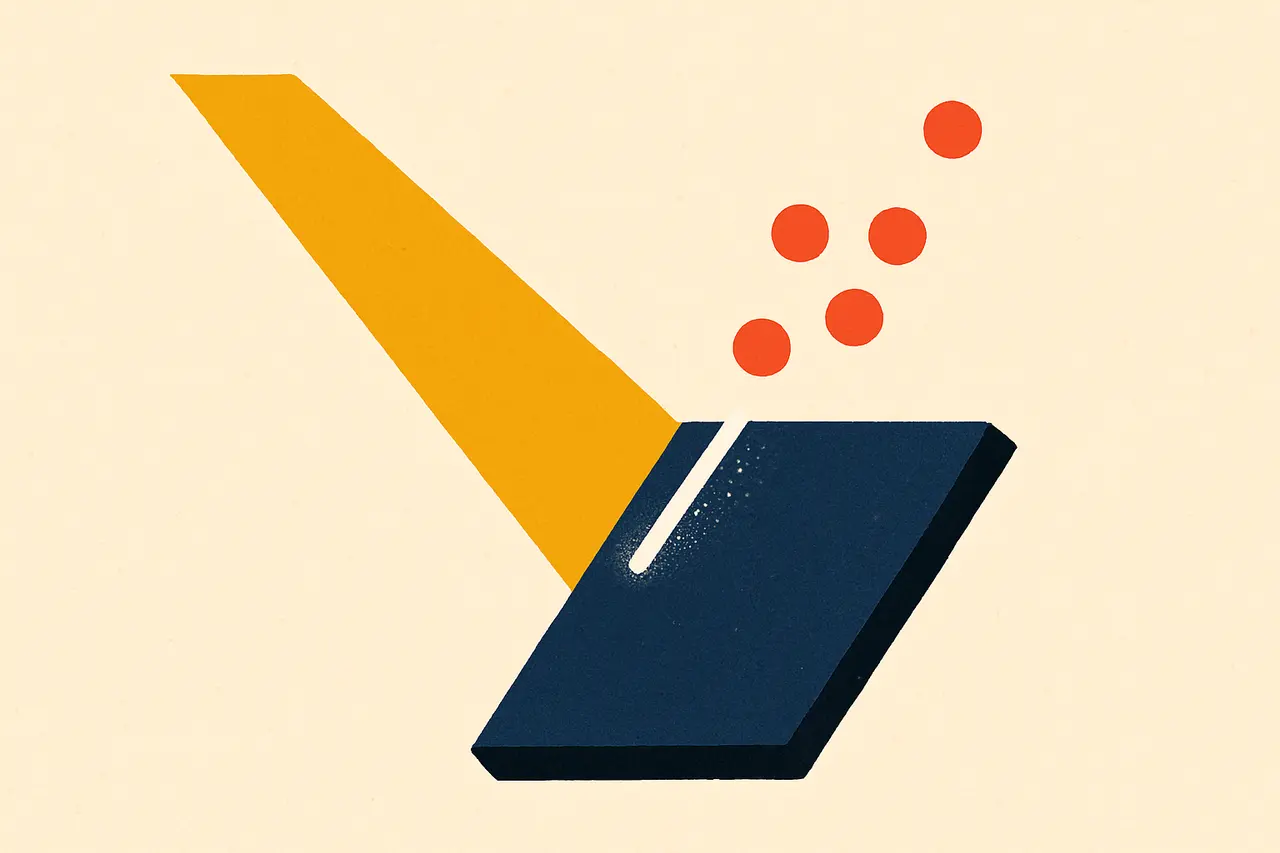
The physics itself: light falling on a metal can knock electrons loose, but only if its frequency is above a threshold, whereas classical theory said the light’s intensity should be what mattered. In 1905, while working at the patent office in Bern, Einstein explained this by treating light as packets, now called photons, each with energy E = hf, Planck’s constant times the frequency.
The sceptic who proved him right
The decisive evidence came from a physicist who expected the equation to fail. Robert Millikan, convinced by the mass of evidence that light was a wave, spent about a decade testing Einstein’s prediction, even devising ways to scrape the metal surfaces clean inside his vacuum tube. His 1916 results confirmed the equation in every detail and pinned down Planck’s constant to about 0.5%. Yet he still wrote that year:
“Einstein’s photoelectric equation… cannot in my judgment be looked upon at present as resting upon any sort of a satisfactory theoretical foundation.” (Robert Millikan, 1916)
Millikan’s experiment helped convince the experiment-minded committee in Stockholm to honour Einstein, and Millikan took the 1923 physics prize partly for the same work.
One irony remains. Einstein’s Nobel lecture, delivered in Gothenburg on 11 July 1923, was titled “Fundamental ideas and problems of the theory of relativity”, the very theory his prize citation had left out.
Sources & references
5 referencesWell-established. Corroborated by 2 independent sources.