Graphene is the strongest material — with a big catch
One-atom-thick graphene is over 100 times stronger than steel, but the record was set on flawless specks. Real-world sheets crack far more easily.
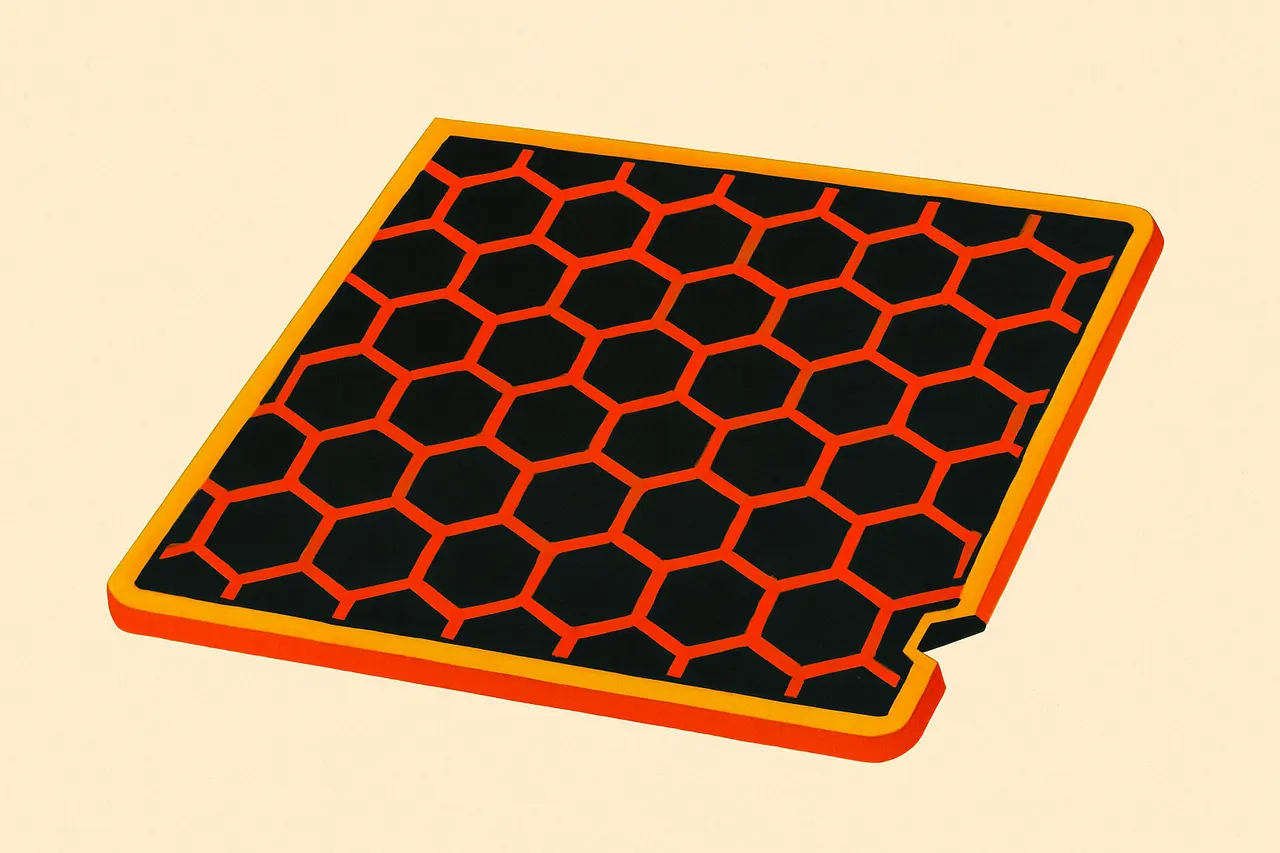
Graphene, a single layer of carbon atoms in a honeycomb lattice, is the strongest material ever measured: the U.S. Department of Energy says it is more than 100 times stronger than steel, and it is often quoted at 200 times. The catch, which most summaries skip, is that the record was set on flawless flakes a few micrometres across.
In 2008, Columbia University engineers James Hone and Jeffrey Kysar laid graphene over holes just 1 to 1.5 micrometres wide in a silicon wafer, then pressed the diamond tip of an atomic force microscope into each sheet until it broke. The defect-free flakes had an intrinsic strength of 42 newtons per metre. Hone put that in everyday terms:
“If a sheet of cling film (which typically has a thickness of around 100 µm) were to have the same strength as pristine graphene, it would require a force of over 20,000 N to puncture it with a pencil. That is the force exerted by a mass of 2000 kg, or a large car!” — James Hone, 2008
Those samples were flawless because they were so small. Larger sheets made industrially by chemical vapour deposition are polycrystalline, stitched from many grains with defects along the seams.
That matters because strength (resistance to deforming) and toughness (resistance to a spreading crack) are different properties, a distinction that also comes up when spider silk is compared with steel. In 2016, Berkeley Lab’s Robert Ritchie found that polycrystalline graphene is strong but has low toughness, below diamond and only a little above plain graphite. His illustration: a single sheet of perfect graphene could support a soccer ball, but a polycrystalline sheet could hold only a ping-pong ball.
Graphene was first isolated in 2004 by Andre Geim and Konstantin Novoselov, who peeled flakes off graphite with ordinary adhesive tape. The work won the 2010 Nobel Prize in Physics, and the Nobel committee called graphene both the thinnest and the strongest material ever.
Sources & references
4 referencesWell-established. Corroborated by 4 independent sources.