GPS Would Fail Without Einstein's Relativity
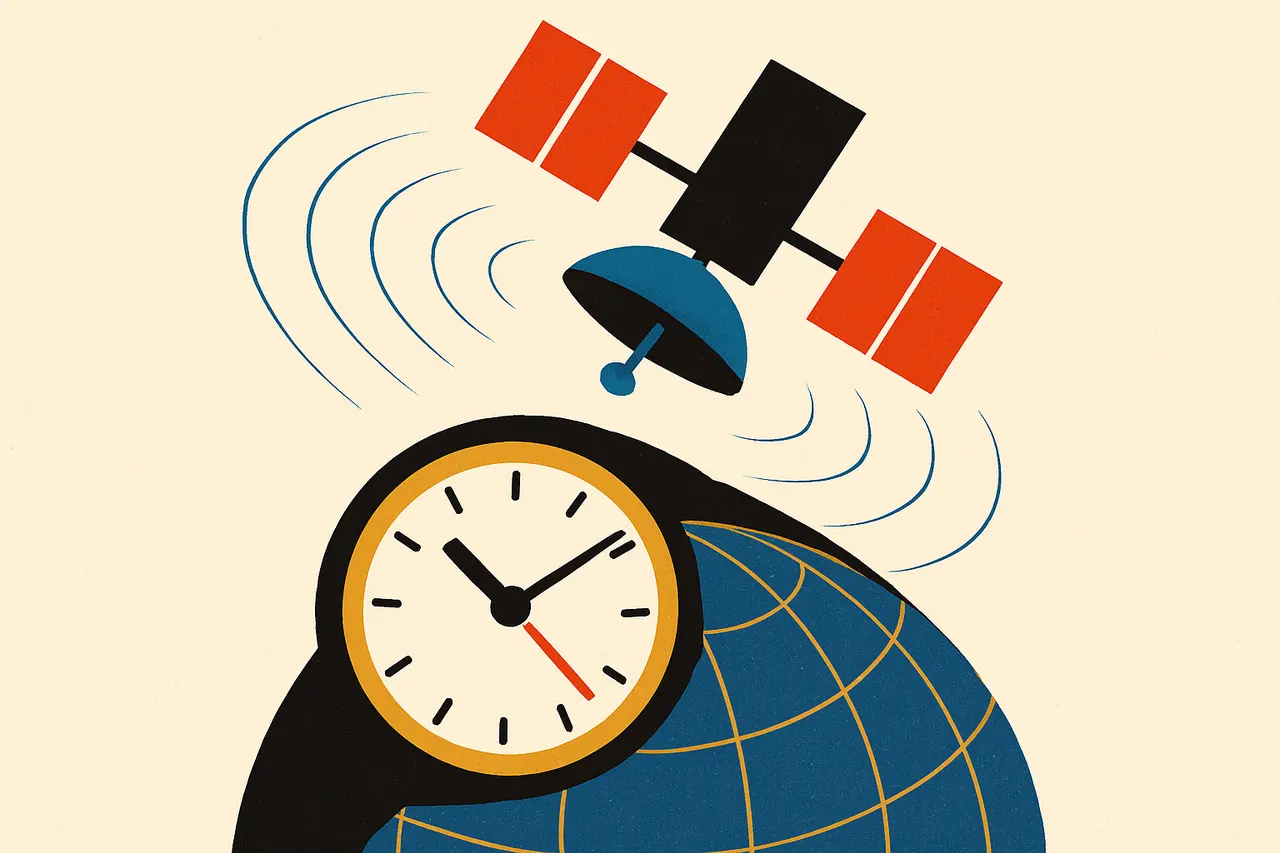
Orbiting clocks tick 38 microseconds a day too fast, and without correcting for relativity your location would drift miles every day.
Satellite navigation works by timing radio signals to billionths of a second — which means it has to take Einstein seriously. Two of his theories tug on every GPS clock in opposite directions, and they refuse to cancel.
The satellites race around their orbits at roughly 3.9 kilometers per second, and special relativity says a fast-moving clock ticks slow — here, about 7 microseconds per day behind a clock on the ground. But each satellite also sits about 20,200 kilometers up, where Earth’s gravity is weaker. What matters to general relativity is gravitational potential, not just altitude: a clock deeper in a gravity well runs slow, so a clock in the shallower well up high runs fast — by about 45 microseconds per day.
Add a 45-microsecond gain to a 7-microsecond loss and the net is a clock running roughly 38 microseconds per day too fast.
Tiny as that sounds, it is ruinous. Light travels about 30 centimeters per nanosecond, so an error of 38 microseconds maps to error in position — compounding to nearly 10 kilometers per day if no one corrects it.
That is the deep point: GPS accuracy is fundamentally a timing problem, not a triangulation-geometry one. Get the clocks wrong and the geometry is exact but useless. So engineers build the physics in before launch, deliberately tuning each satellite’s clock to tick at a slightly lower frequency on the ground so it runs at the correct rate once it reaches orbit. GPS is, in effect, a permanent global test of relativity that you carry in your pocket.
Sources & references
2 referencesWell-established. Corroborated by 2 independent sources.