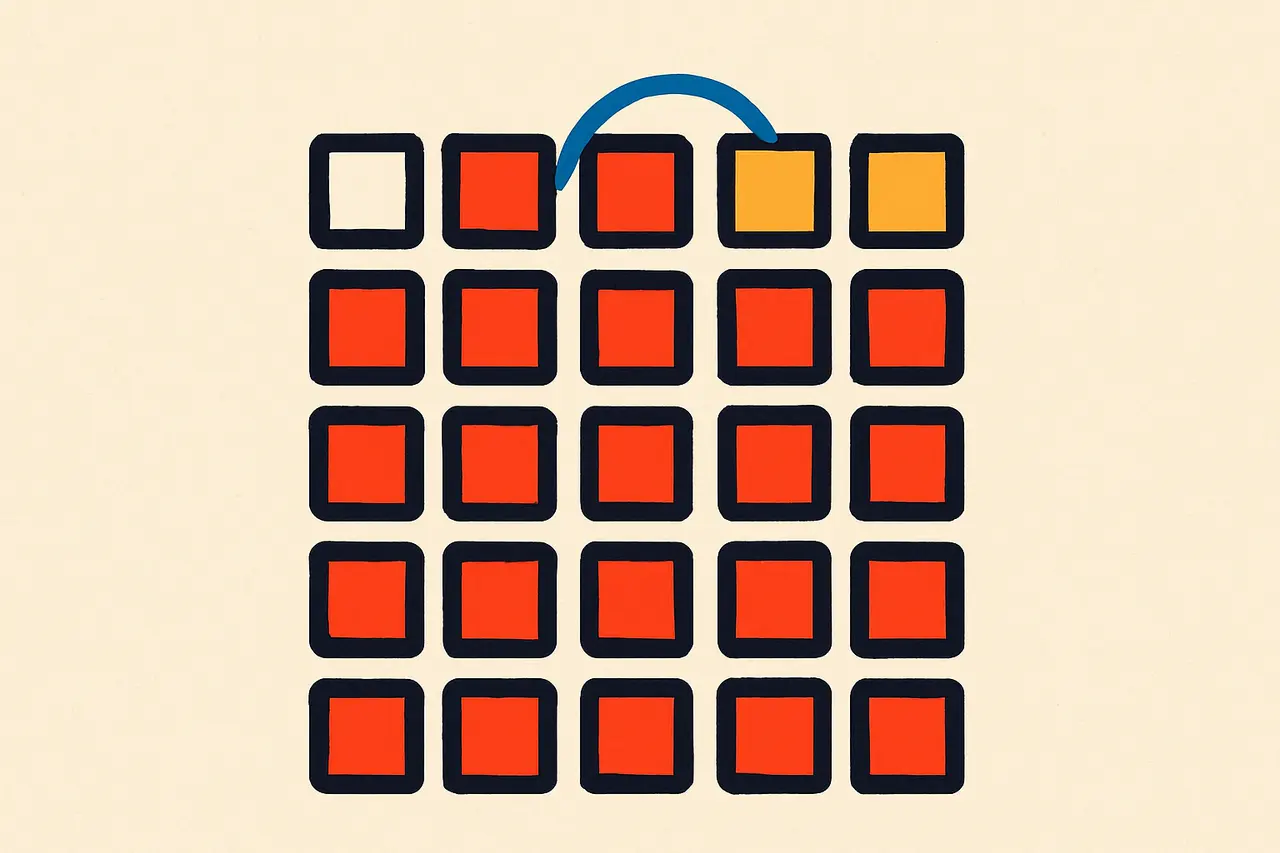
Fold paper 42 times and it would reach the Moon

A 0.1 mm sheet folded 42 times would pass the Moon. You'd need a sheet the size of Colorado, and the record is just 12 folds.
A sheet of paper 0.1 millimetres thick, folded in half 42 times, would make a stack about 440,000 km tall, enough to pass the Moon, which orbits an average of 384,400 km from Earth. Each fold doubles the thickness, so after n folds the stack is 0.1 mm × 2ⁿ.
Doubling starts slowly and then runs away. After 41 folds the stack is only about 220,000 km tall, a little over halfway; the 42nd fold doubles it past the Moon. Keep going and the numbers become absurd: MathWorld notes that 51 folds would make the stack taller than the distance from the Earth to the Sun.
Can you only fold paper in half seven times?
No. A common claim says no sheet can be folded in half more than 7 times, and Guinness puts the accepted limit at 8. On 27 January 2002, Pomona, California high-school student Britney Gallivan folded a single sheet in half 12 times, the record, using a strip of tissue paper 4,000 ft (1,219 m) long.
Why does each fold get so much harder?
Because a folded stack is not neat flat layers: each fold wraps round the layers inside it, wasting paper in curved edges. Gallivan succeeded because she had worked this out. In December 2001 she derived a formula for the minimum length needed, L = πt/6 (2ⁿ + 4)(2ⁿ − 1), where t is the thickness and n the number of folds. Each extra fold roughly quadruples the length required.
That is why the Moon stays out of reach. Illustrative Mathematics estimates that to end with a moon-tall stack the size of an ordinary sheet, you would have to start with a piece of paper roughly the size of Colorado.
Sources & references
4 referencesWell-established. Corroborated by 4 independent sources.