Modern tuning splits the octave into 12 equal steps — using the 12th root of 2
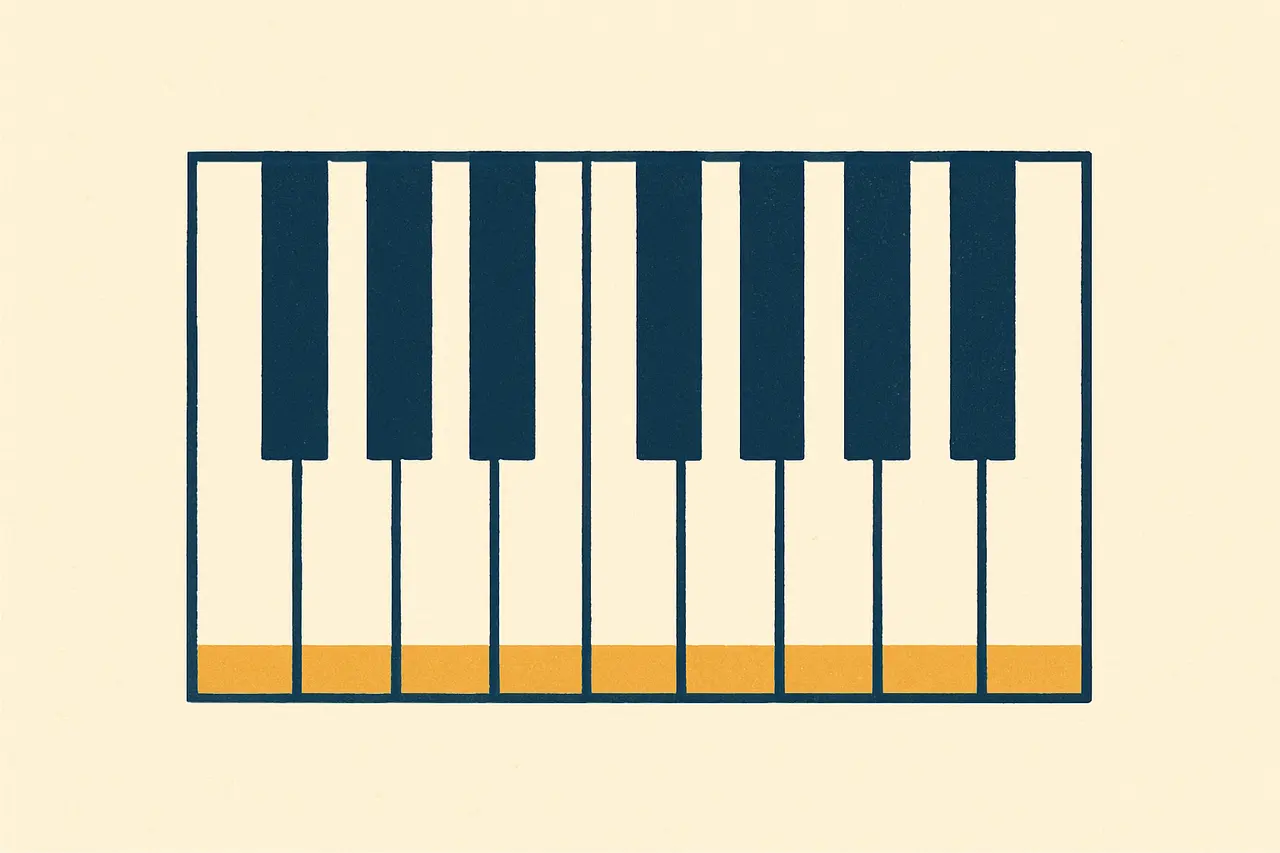
To let a piano play in every key, we deliberately tune almost every interval slightly out.
Western instruments are tuned by equal temperament: the octave is divided into 12 semitones of equal size. Because an octave is a 2:1 ratio, each semitone is a frequency ratio of the twelfth root of 2 — about 1.0595. Multiply a note’s frequency by that twelve times and you arrive back at exactly double, a perfect octave.
The reason this compromise exists is a stubborn quirk of acoustics called the Pythagorean comma. Stack twelve pure perfect fifths and you should, in theory, land on seven octaves — but you overshoot by about 23.5 cents, nearly a quarter of a semitone. That leftover gap can’t be wished away; equal temperament’s job is to absorb it by shaving a tiny amount off every fifth, so a fifth like C-G runs about 2 cents narrower than the natural fifth — a difference almost no one can hear.
Earlier systems refused that even spread. Meantone and well temperaments kept some intervals pure but dumped the error into one unusable interval, the notorious “wolf fifth” that howled out of tune, and distant keys sounded increasingly sour.
Equal temperament spreads the compromise evenly, keeping only the octave perfectly pure.
The payoff is that every key becomes equally playable. J. S. Bach celebrated exactly this with “The Well-Tempered Clavier”, a set of preludes and fugues running through all 24 major and minor keys to show that none was off-limits. The mathematics had been worked out independently around 1600 by the Chinese prince and theorist Zhu Zaiyu and the Flemish-Dutch engineer Simon Stevin, both of whom derived the twelfth root of 2 — the number that lets a single piano play in every key.
Sources & references
2 referencesWell-established. Corroborated by 2 independent sources.