The 1919 eclipse really did prove Einstein right
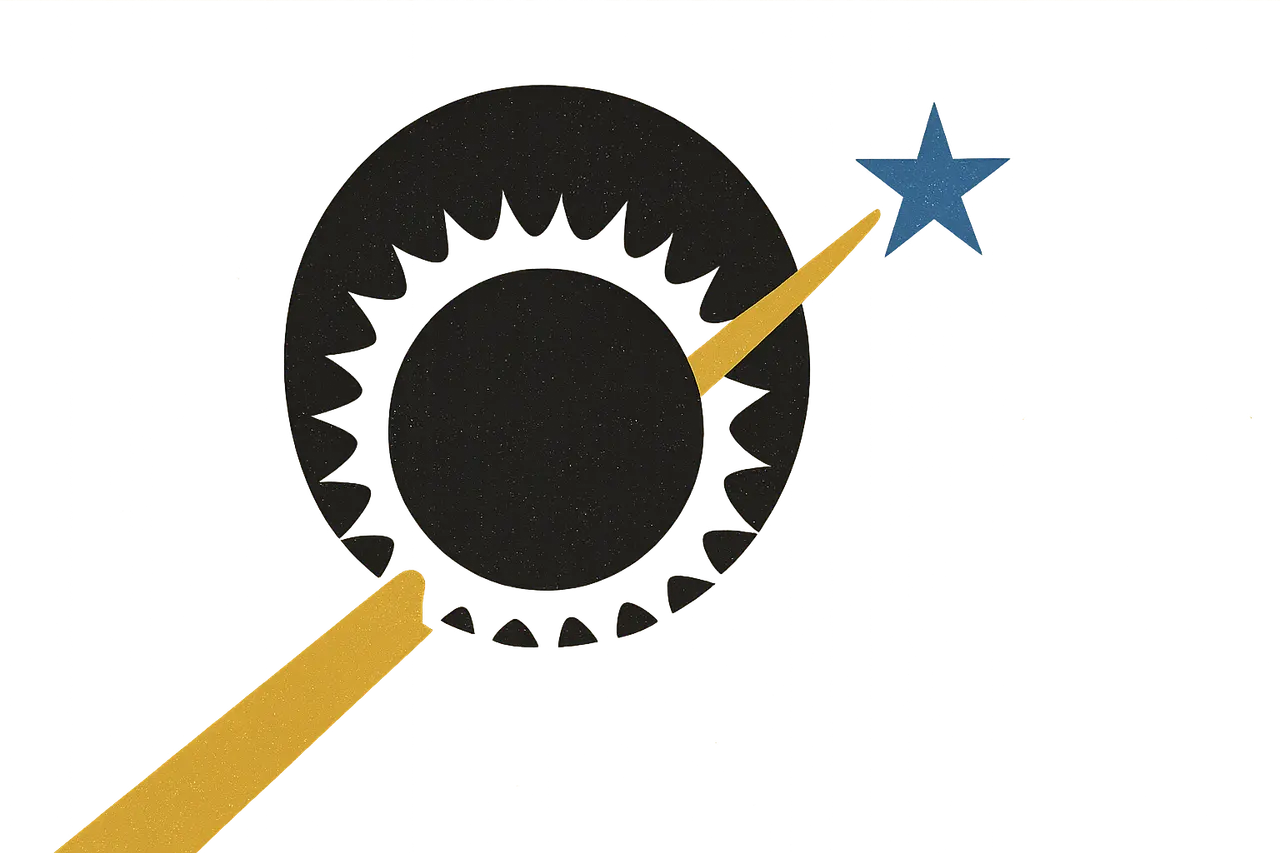
Eddington's 1919 eclipse plates showed starlight bending as Einstein predicted, and a 1979 re-measurement undercut claims that he cherry-picked them.
During the total eclipse of 29 May 1919, British astronomers photographed stars beside the darkened Sun and found their light bent by its gravity by roughly the amount Einstein’s general relativity predicted, about twice what a Newtonian calculation gives. The shift is tiny, less than two arcseconds even for stars at the Sun’s edge.
A Cambridge team led by Arthur Eddington went to Príncipe, off West Africa, and a Greenwich team to Sobral in Brazil. Both photographed stars of the Hyades cluster during totality and compared them with images of the same stars in the night sky. The results were announced at a joint Royal Society and Royal Astronomical Society meeting; ESA dates it to 8 November, but the meeting’s own report in The Observatory gives 6 November 1919.
Did Eddington cherry-pick the data?
No. A persistent claim says Eddington, already convinced by Einstein, threw out the measurements that didn’t fit, but the plates tell a duller story. Clouds at Príncipe left only two plates good enough to measure. At Sobral, the 19 plates from the main astrographic lens came out blurred, probably because the Sun’s heat distorted the mirror feeding it; depending on assumptions they leaned towards Newton or Einstein, with uncertainties too large to use. The seven good plates from a smaller 4-inch lens matched Einstein’s prediction, including how the shift fell off with distance from the Sun.
In 1979, astronomer G. M. Harvey re-measured the Sobral plates with modern machines and got essentially the same answer, and historian Daniel Kennefick has since put the selection charge to rest.
How precisely has light bending been confirmed since?
To within one part in a thousand, but only once the test moved to space. Eclipse tests stayed rough for decades; critics still allowed for a 20% error. The decisive check came from ESA’s Hipparcos satellite (1989–93), which measured light bending across the whole sky and confirmed Einstein’s prediction to that precision.
Sources & references
5 referencesWell-established. Corroborated by 3 independent sources.