Diamond is the hardest mineral — but a hammer can shatter it
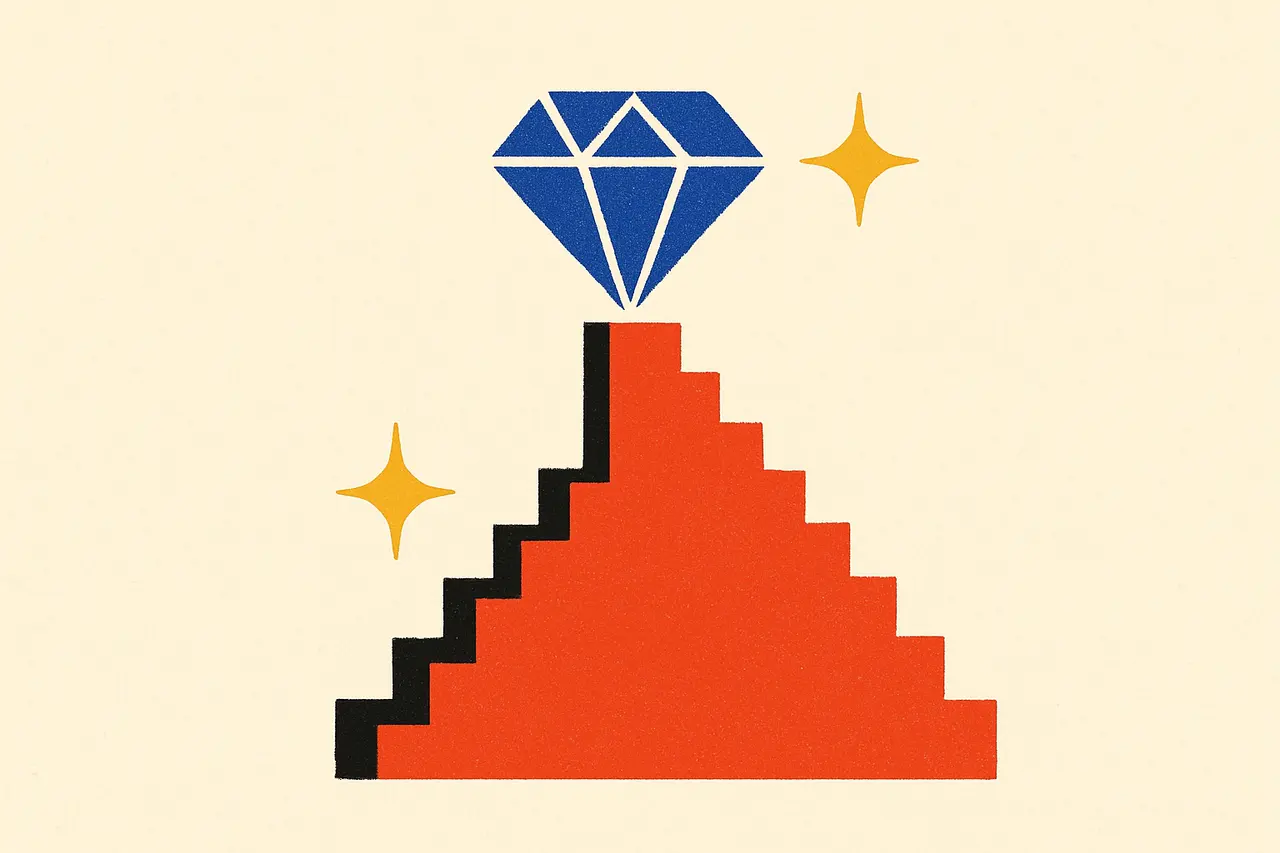
Diamond tops the Mohs scale at 10, four to five times harder than the runner-up. Yet hardness isn't toughness: a steel hammer can still break it.
Diamond is the hardest natural mineral, the 10 at the top of the Mohs scale, and the single step down to corundum (ruby and sapphire) at 9 hides a jump of roughly four to five times in actual hardness. The reason is that the scale, devised by Austrian mineralogist Friedrich Mohs in 1812, only ranks minerals by which one scratches which; it doesn’t measure the distance between them.
How much harder is diamond than corundum?
About four to five times, depending on the method. Measured with indenting tools, the scale turns out close to exponential: gypsum (2) is only slightly harder than talc (1), and corundum is about twice as hard as topaz (8). The International Gem Society says diamond is four times as hard as corundum, while a university mineralogy textbook puts it at five. Either way, that last step is wider than the whole climb from talc to corundum.
For everyday reference, a fingernail rates about 2½, a copper penny 3½ and a pocketknife 5½. Quartz, at 7, is common in household dust, which is why dust can scratch glass, car finishes and softer gems. Only a diamond can scratch another diamond.
Can a hammer break a diamond?
Yes. The belief that a real diamond will survive a hammer blow is wrong, because hardness measures resistance to scratching, not to breaking. Gemmologists’ old saying holds that a hammer will shatter a diamond, split quartz in two and make jade ring like a bell. A steel hammer, at about 5 to 6, can’t scratch a diamond, but it can break one, because diamond is brittle and has perfect cleavage: planes of weaker bonding along which it can chip or split when struck.
Hardness reflects a mineral’s weakest bonds, and minerals built on strong covalent bonding, like diamond’s network of carbon atoms, tend to be the hardest. Those same strong bonds resist scratching, but they cannot stop a sharp blow from opening a cleavage plane, which is why even a diamond ring needs protecting from knocks.
Sources & references
5 referencesWell-established. Corroborated by 3 independent sources.