Why 23 people give a 50% chance of a shared birthday
With just 23 people in a room, the odds that two share a birthday pass 50%, and World Cup squads prove it.
In a group of just 23 people there is a 50.7% chance that at least two share a birthday, and with 57 people the probability rises to about 99%. With 365 possible birthdays that sounds far too low, which is why it is called the birthday paradox, even though nothing about it is contradictory.
Why are so few people enough?
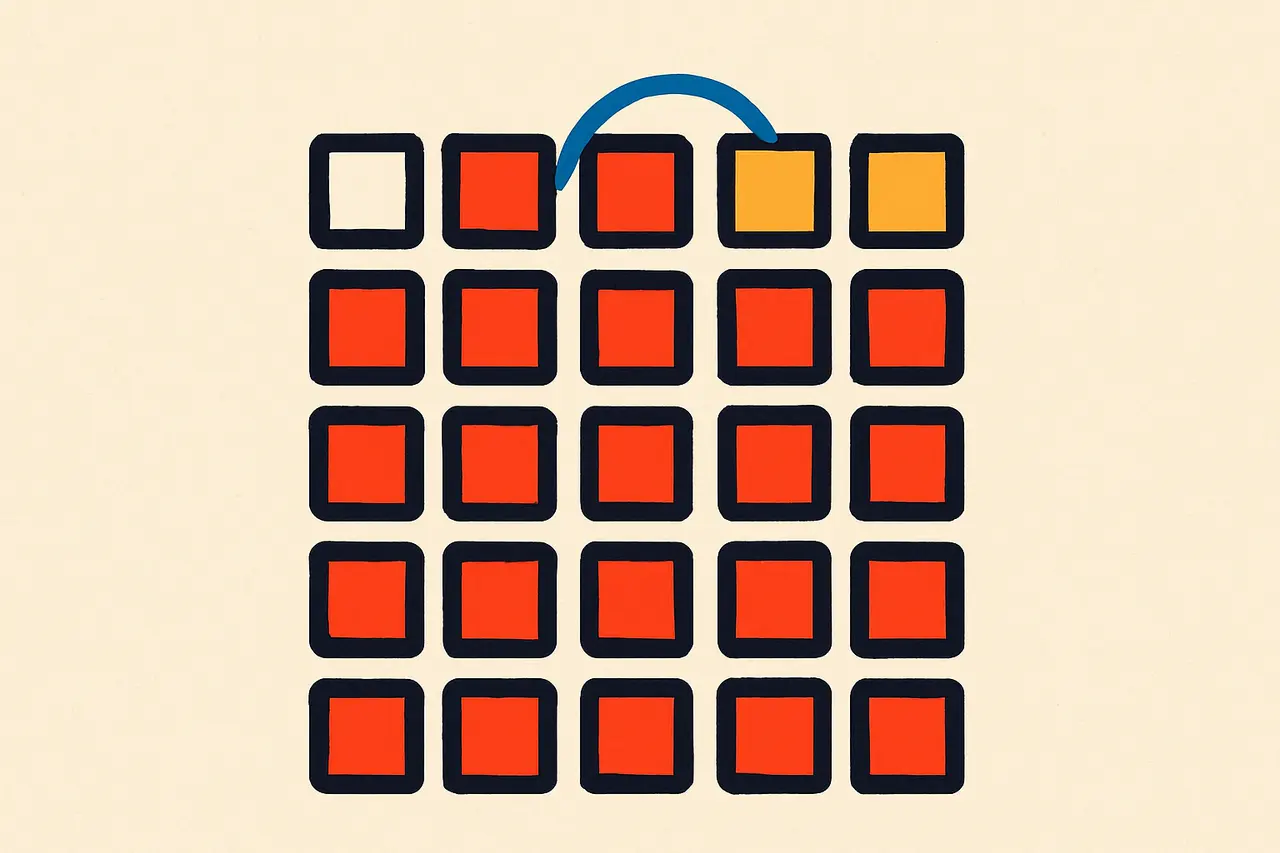
Because a match can come from any pair, not just from you. Intuition fails because we think about our own birthday: the chance that one particular stranger shares yours is only 1 in 365. But 23 people make 22 + 21 + … + 1 = 253 pairs, each a separate chance of a match.
The cleanest way to get 50.7% is to count the opposite event: the chance of no match. The first person can have any birthday, the second must avoid it (364/365), the third must avoid both (363/365), and so on down to 343/365 for the twenty-third. Multiply that chain and you get about 0.493, leaving roughly 50.7% for at least one shared birthday.
Does it work in real life?
Yes. In 2014 the BBC tested it on the football World Cup, where each of the 32 squads had exactly 23 players. Using FIFA’s official squad lists, 16 squads, precisely half, had at least one shared birthday, and five had two pairs. Adding the 2010 tournament gave 31 of 64 squads, still close to 50%.
The textbook figure also assumes every day of the year is equally likely, and real births are not like that: more babies arrive in August and September, and more on Mondays and Tuesdays than at weekends. That unevenness only raises the chance of a match, because people are crowded onto fewer popular days. Murray Klamkin studied uneven birthdays in 1967, and D. Bloom proved in 1973 that a perfectly even spread gives the lowest possible odds. So 50.7% is a floor, not an overestimate.
Sources & references
5 referencesWell-established. Corroborated by 5 independent sources.