Ancient Egyptians weighed the heart against a feather to judge the dead
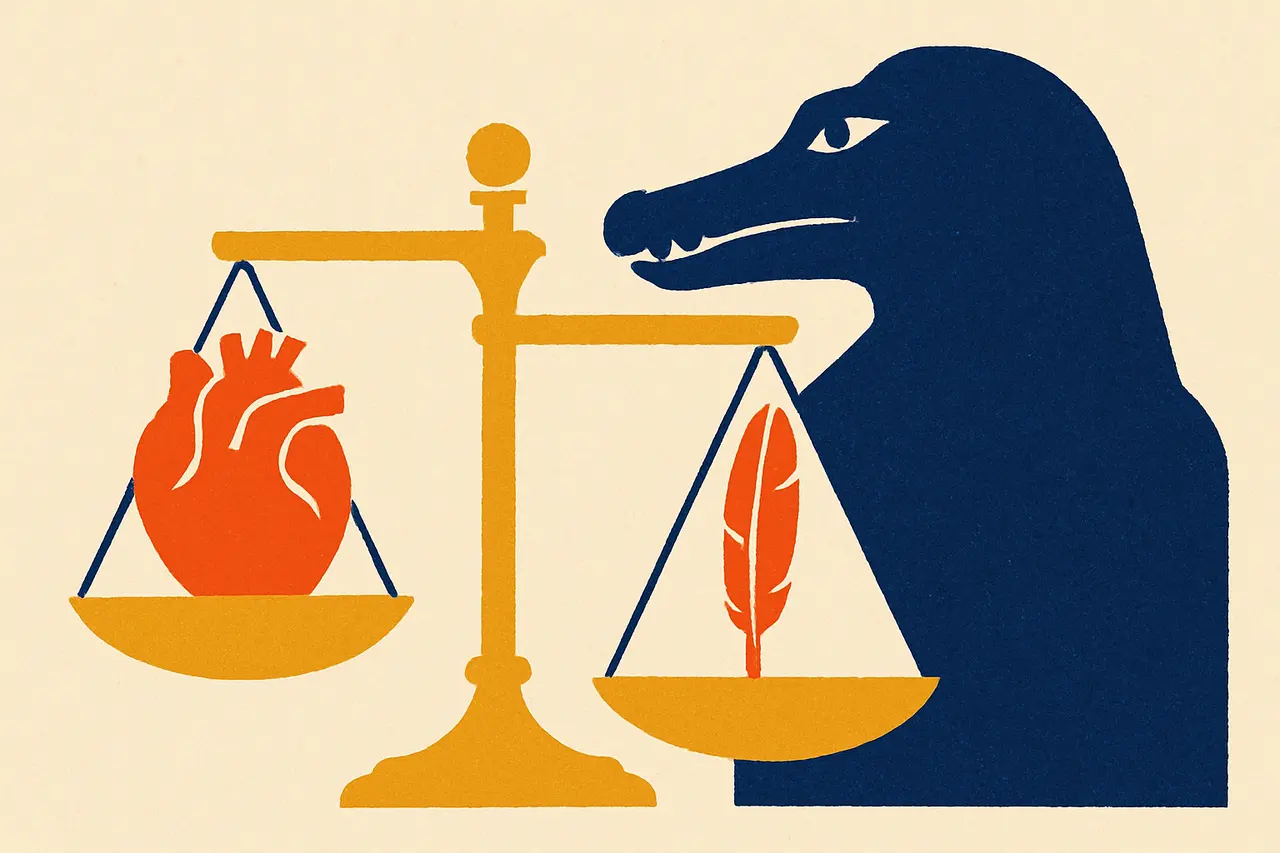
In the Egyptian afterlife your heart was set on a scale against a single feather — and a heavy one meant a monster ate it.
For the ancient Egyptians, the fate of the dead came down to a balance scale and a feather. In the Book of the Dead — its true title closer to the Book of Coming Forth by Day — the deceased was led into a hall of judgment where the heart, believed to record every deed of a life, was placed on one pan of a great scale.
On the other pan sat a single feather: the plume of Maat, the goddess of truth, order, and justice. A peer-reviewed account in a journal hosted by the U.S. National Institutes of Health describes the scene precisely — “the heart of the deceased is weighed in the scale against the feather of the goddess Maat” — and spells out the stakes: “If the heart weighed more than the feather of Maat, it was immediately consumed by the monster Ammit.”
A heavy, deed-laden heart, in other words, failed the test. The waiting devourer — part crocodile, part lion, part hippopotamus — swallowed it whole. The World History Encyclopedia notes the chilling consequence: once the heart was eaten, “the individual soul then ceased to exist,” a fate worse than death, since Egypt had no hell, only oblivion.
If the heart was lighter than the feather, the soul could pass on toward the bliss of the Field of Reeds.
It is one of history’s most vivid moral cosmologies: a life’s goodness made literally weighable.
Sources & references
2 referencesWell-established. Corroborated by 2 independent sources.