A jet engine works by squeezing air, setting it on fire, and shoving it backward
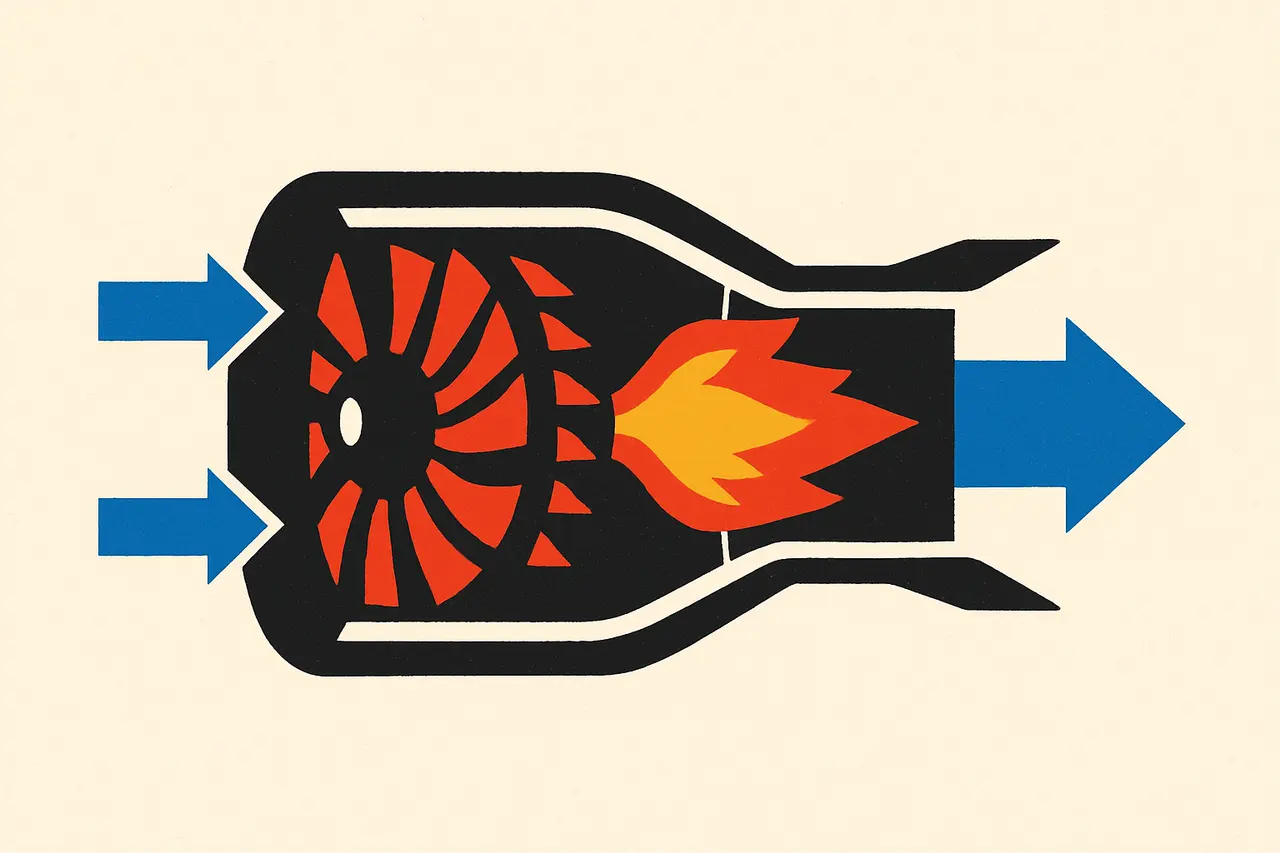
Suck, squeeze, burn, blow: a turbojet is a continuous explosion aimed out the back, and Newton's third law does the rest.
Strip away the engineering and a jet engine does something almost crude: it pushes air backward so the plane goes forward. That’s Newton’s third law — every action has an equal and opposite reaction — turned into thrust. NASA describes a turbojet as a machine that accelerates a working fluid; the reaction to that acceleration is the force on the aircraft.
The cycle runs in four stages. First, air rushes into the inlet. Then the compressor — “many rows of airfoils, with each row producing a small jump in pressure,” as NASA puts it — squeezes that air to many times its original pressure. In the burner, fuel is sprayed in and ignited; in a typical engine, just 2 pounds of fuel join every 100 pounds of air per second, yet the mix releases enormous heat.
That blast of hot gas tears out the back, but first it passes through the turbine, which “works like a windmill,” spinning blades to harvest energy. A central shaft carries that energy forward to drive the compressor — so the engine powers its own air supply, keeping the cycle self-sustaining. Finally the nozzle accelerates the exhaust to high speed, and because it leaves faster than the air came in, thrust is born.
The concept was patented by Frank Whittle in the early 1930s; his bench engine first roared to life on April 12, 1937.
Sources & references
2 referencesWell-established. Corroborated by 2 independent sources.